Comparisons
This guide is useful both for those thinking of adopting or switching to DeepEval.
If you judge a fish by its ability to climb a tree, it will live its whole life believing that it is stupid.
Below are some non-detailed reasons why you may want to use DeepEval for fast local evaluation and iteration of AI agents and LLM apps.
vs Other Eval Libraries
- Widely adopted - DeepEval is used by teams at companies like Google, OpenAI, Microsoft, and other leading AI organizations.
- Agent-first evals - DeepEval supports traditional output scoring, but is especially strong for AI agents, tool calls, traces, spans, MCP systems, and multi-step workflows.
- Fast local loop - Run evals locally while changing prompts, tools, models, or code, then inspect failures without leaving your development workflow.
- Modular primitives - Build your own eval pipeline from test cases, datasets, metrics, traces, spans, custom models, and synthetic goldens.
- Largest eval metric library - Start with one of the broadest libraries of ready-to-use LLM evaluation metrics instead of assembling scattered scorers.
- Pytest and CI/CD - Turn evals into pass/fail tests that fit existing engineering workflows.
- Research-backed metrics - Use custom LLM-as-a-judge metrics like G-Eval, alongside AI agent, multi-turn, voice, RAG, safety, and multimodal metrics.
- Path to production - Start open-source and local. Once you ship, Confident AI surfaces failing production traces and turns them into goldens for your next eval.
- Proprietary evaluation techniques - Go beyond prompt-only scoring with DeepEval-native techniques like DAG, which lets you build deterministic, decision-graph-based evals.
vs LLM Observability Platforms
- Local iteration first - Run evals while you code, without waiting on a hosted dashboard or production telemetry pipeline.
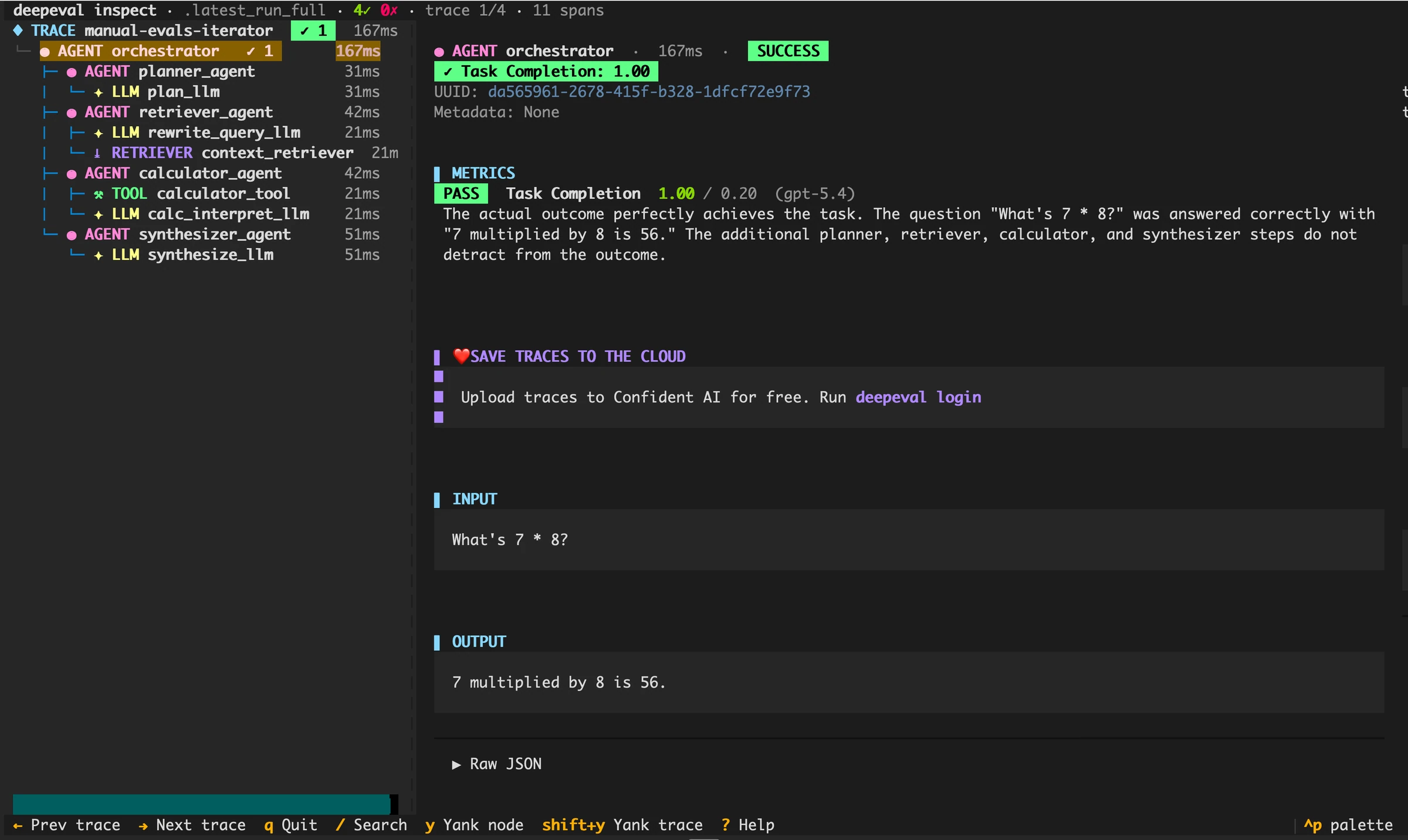
- Local traces - Inspect traces and spans from development runs, including tool calls, planners, retrievers, generators, and other agent components.
- Evaluation-first - DeepEval is built around metrics, test cases, datasets, traces, and CI/CD gates, not only logs and dashboards.
- Pytest-native - Add pass/fail evals to the same workflows you already use for software tests.
- Agentic coding tools - Save eval results locally so tools like Cursor or Claude Code can inspect failures, compare runs, and help iterate on prompts or code.
- Production feeds back into evals - Keep local development simple. Once you're live, Confident AI runs evals on every production trace and flags the failing ones, so they can become test cases for your next local run.
Net effect: edit → rerun → deepeval inspect in under a second, no dashboard round-trip.
PS. DeepEval also allows you to view traces locally on your machine.
vs RAG-Only Evaluation Libraries
- AI agents beyond RAG - DeepEval supports RAG, but also evaluates AI agents, multi-turn chatbots, voice agents, MCP systems, tool-use workflows, LLM arenas, and custom applications.
- Trace and span evals - Score individual runtime components instead of only evaluating final answers or retrieval quality.
- Faster debugging loop - Run a trace locally, inspect which span failed, and update the agent without switching tools.
- More metric coverage - Use RAG metrics alongside AI agent, multi-turn, voice, safety, multimodal, task completion, and custom metrics.
- Testing workflow - Run evals through Pytest, CI/CD, local scripts, or production trace evaluation.
- Synthetic data generation - Generate goldens for edge cases when manually curated datasets are not enough.
vs Prompt/Experiment Platforms
- Code-first control - Keep eval logic, metrics, datasets, and traces close to your application code.
- Fast prompt and tool iteration - Change a prompt, tool schema, model, or agent step, then rerun the same eval immediately.
- Custom metrics - Write your own metrics or customize built-in LLM-as-a-judge prompts instead of relying only on platform-provided scoring.
- Repeatable regression tests - Turn experiments into tests that block low-quality prompt, model, or agent changes before they ship.
- AI coding-agent friendly - Local JSON results and test files give coding agents concrete artifacts to read, compare, and edit against.
- Works with your stack - Bring your own model providers, app framework, tools, retrievers, and CI provider.
vs Rolling Your Own Evals
- Metrics built in - Start with 50+ metrics instead of building every scorer from scratch.
- Tracing built in - Capture traces and spans without designing your own evaluation data model.
- Local display built in - See eval results and trace-linked failures during development instead of building your own reporting loop.
- Dataset primitives - Reuse goldens across prompts, models, releases, and system variants.
- CI/CD ready - Use
deepeval test runto turn evals into deployment gates. - Production path - Move from local evals to shared reporting and monitoring without rewriting your evaluation workflow.